Fresh Paint

November 2026

← The latest briefs

Picture book art

Picture books that are woven, stitched and quilted

A new exhibition at the Eric Carle Museum of Picture Book Art in Amherst, Massachusetts, gathers art from 32 picture books, all tied to fiber. Some illustrators painted the look of a woven rug or a woven coat; others stitched and quilted the pictures themselves, like Faith Ringgold’s story quilt Tar Beach 2. Weaving Words runs through May 2, 2027.

In the studio

For little hands: Press a scrap of burlap or lace into wet paint, then stamp it on paper to print its woven texture.

For grown-ups: Paint a memory on a paper square, then join squares with yarn through punched holes into a small story quilt.

Read the full story at The Eric Carle Museum of Picture Book Art carlemuseum.org · Image: Juana Martinez-Neal, La Princesa and the Pea; The Eric Carle Museum of Picture Book Art
Northwest glass

A glass master’s gift opens in Tacoma

One of the world’s great glassblowers has left his work with his neighbors. Lino Tagliapietra, an Italian artist born in 1934, lived in the Puget Sound area for 45 years and gave 175 pieces to Tacoma’s Museum of Glass. On December 12, more than 50 of them open in a new gallery, many built from fine threads and tiny slices of colored glass.

In the studio

For little hands: Cut thin strips of colored tissue paper, press them onto clear contact paper, and hold your glass up to a window.

For grown-ups: Paint watercolor stripes, let them dry, then cross them with a second layer to see new colors weave together.

Read the full story at Museum of Glass museumofglass.org · Image: Lino Tagliapietra, Fuji, 2012, blown murrine glass. Museum of Glass

In the library Transmitted Light

Ice Age color

Ice Age rock carvings may once have worn color

In Portugal’s Côa Valley, Ice Age artists pecked horses and wild cattle into open hillside rock with stone tools. Now archaeologists digging beside one rock at Penascosa have found hundreds of pigment fragments more than 27,000 years old: red and yellow ochre, black and brown. The carvings may once have been painted too, with the color long since washed away by weather.

In the studio

For little hands: Scratch an animal into a flat slab of clay with a craft stick, then rub red and yellow chalk into the lines.

For grown-ups: Mix ochre powder with water and a little gum arabic, and paint with the earth colors Ice Age artists had.

Read the full story at RTP Notícias (Lusa) rtp.pt · Image: Marcos Borga / Lusa

In the library Dripstone Caves

Natural indigo

Two thousand words for rain, drawn in indigo

Japanese has a word for almost every kind of rain, from a soft drizzle to an evening shower that drifts from mountain to mountain. Artist Miya Ando collected 2,000 of them, then drew each one in natural indigo, graphite and pure silver powder on handmade paper. Her rain drawings are on view at The Japan Foundation, Los Angeles, through January 23.

In the studio

For little hands: Paint a sheet blue, then draw rain on it with a silver crayon, and invent a name for your kind of rain.

For grown-ups: Keep a rain journal for a week: one word and one quick blue watercolor wash for each day’s weather.

Read the full story at The Japan Foundation, Los Angeles la.jpf.go.jp · Image: The Japan Foundation, Los Angeles

Botanical art

Sixteen artists look closely at plants and fungi

A new show at the Coastal Discovery Museum on Hilton Head Island, South Carolina, gathers sixteen artists who study plants and fungi up close. Katie DeGroot paints mossy, lichen-crusted twigs in watercolor, every tiny cup drawn by hand. Elaine Quave sculpts a pink wildflower and a black swallowtail butterfly in porcelain. Botanica is free and runs through March 2027.

In the studio

For little hands: Bring a fallen twig inside, look with a magnifying glass, and paint every bump and fuzzy patch you find.

For grown-ups: Try painting moss with many tiny strokes of two greens, letting each layer dry before adding the next.

Read the full story at Coastal Discovery Museum coastaldiscovery.org · Image: Katie DeGroot, The Posers, watercolor on paper; Coastal Discovery Museum

Also worth a glance In the same show, Elaine Quave’s porcelain swallowtail lands on a pink blazing star wildflower. Take a look →

Art meets lake science

A fishing guitar and a lens full of Lake Tahoe

At Lake Tahoe, an artist and a scientist spent a semester working side by side. Sculptor Lawrence LaBianca and Rene Henery of Trout Unlimited rode a university research boat, filled a clear lens with water from the middle of the lake, and built a fishing guitar to catch its vibrations. Their gallery, part studio and part lab, stays up into early 2027.

In the studio

For little hands: Fill a clear jar with water, look at a toy through it, and draw how its shape bends.

For grown-ups: Sit by moving water for ten minutes, then paint only the patterns you heard, not what you saw.

Read the full story at University of Nevada, Reno · Nevada Today unr.edu · Image: University of Nevada, Reno

In the library Caustics & Symmetry

Art education
Making art by hand, as an antidote to screens

Remember when STEM became STEAM? At Getty’s Creative Engagement Forum in Los Angeles on October 3, more than 350 teachers, artists and youth advocates asked what art means now that the A might stand for artificial intelligence. Their shared answer: making things with your hands, in a room with other people, is a powerful antidote to screen time.
In the studio

For little hands: Build a tiny car from a cardboard box and bottle caps, then roll it down a ramp to feel gravity at work.

For grown-ups: Spend one screen-free evening with a sketchbook, drawing the same object three times and noticing what your eyes learn.

Read the full story at Getty News getty.edu · Image: Wendy Cubillo / Courtesy Las Fotos Project, via Getty

Childhood & nature

What do children need from the outdoors?

London’s Foundling Museum stands where an 18th-century hospital once raised abandoned babies. Its new show, Where We Grow, opens today and asks what children need from gardens, playgrounds and parks. Old seed lists and the plant patterns in its 1700s Court Room sit beside new art, like Andy Holden’s tin of speckled eggs nested in cotton wool. Open through April 18.

In the studio

For little hands: Shape eggs from air-dry clay, then speckle them by flicking paint off a toothbrush, like a bird’s shell.

For grown-ups: Sketch a park or garden you played in as a child from memory, then visit and draw it again.

Read the full story at Foundling Museum foundlingmuseum.org.uk · Image: Andy Holden, How the artist was led to the study of nature, 2020. Photograph by Daniel Brown, courtesy the artist

Pigment history

Following an ancient blue back to its mine

About 1,400 years ago, Ancestral Pueblo people ground a bright blue copper mineral called azurite into paint. Now a University of New Mexico team has traced where it came from by reading tiny chemical fingerprints, called isotopes, in the stone. Most samples came from Lisbon Valley near Moab, Utah, and two from New Mexico’s Zuni Mountains, so people traveled far for their blue.

In the studio

For little hands: Crush blue and green sidewalk chalk in a bag, mix the powder with a little water, and paint with your own pigment.

For grown-ups: Paint swatches of every blue you own and label each with the mineral or chemical named on its tube.

Read the full story at University of New Mexico Newsroom news.unm.edu · Image: University of New Mexico

Seattle scene

Telling stories with shapes, yarn and AstroTurf

Seattle’s Frye Art Museum has opened An Indigenous Present, a free show of fifteen Indigenous artists who use abstraction (shapes, lines and color rather than pictures of things) to tell stories about people and places. Teresa Baker’s Knife River is made of yarn, buckskin and willow on a cut sheet of AstroTurf. Another work is drawn in ink and tape. It runs through February 14.

In the studio

For little hands: Map a favorite place using only yarn lines, paper dots and colors, then tell someone which shape is which.

For grown-ups: Try drawing with strips of masking tape and ink: lay tape, brush ink over it, peel, and see what lines remain.

Read the full story at Frye Art Museum fryemuseum.org · Image: Teresa Baker, Knife River, 2024. Photo: Ruben Diaz, courtesy Frye Art Museum

Chinese woodblock

Color prints carved from many wooden blocks

China invented paper, printmaking, and printing in color with several carved blocks. On November 15 the Cleveland Museum of Art opens about 80 prints, paintings and porcelains that tell that story, led by color woodblock prints made in Suzhou in the 1700s. Three hundred years on, their colors are still fresh, and parts of the paper were pressed without ink so shapes stand up in relief.

In the studio

For little hands: Press a leaf into a foam tray, roll on paint and print it, then add a second color with another leaf.

For grown-ups: Carve one small block for each color and print them in turn, lining up the corners to build one picture.

Read the full story at Cleveland Museum of Art clevelandart.org · Image: Cleveland Museum of Art

Ocean art

Step inside the deep sea in Los Angeles

In Los Angeles, the Museum of Contemporary Art opens Julian Charrière’s Deep End on November 15. The artist brings the ocean indoors: dark rooms like the deep sea, works made with ground coral and seafloor mud, and a live stream from a Jamaican coral reef hurt by warm water in 2023. Visitors can listen to the reef, and send their voices into it.

In the studio

For little hands: Draw fish in white crayon, then brush dark blue watercolor over them and watch them glow through.

For grown-ups: Paint the ocean in bands, palest at the surface and deepest blue below, the way sunlight fades with depth.

Read the full story at MOCA Los Angeles moca.org · Image: Julian Charrière, Midnight Zone - 85 Fathoms, 2025, courtesy MOCA

In the library Foundation Species

Art + wellbeing

Scientists suggest an hour of art every month

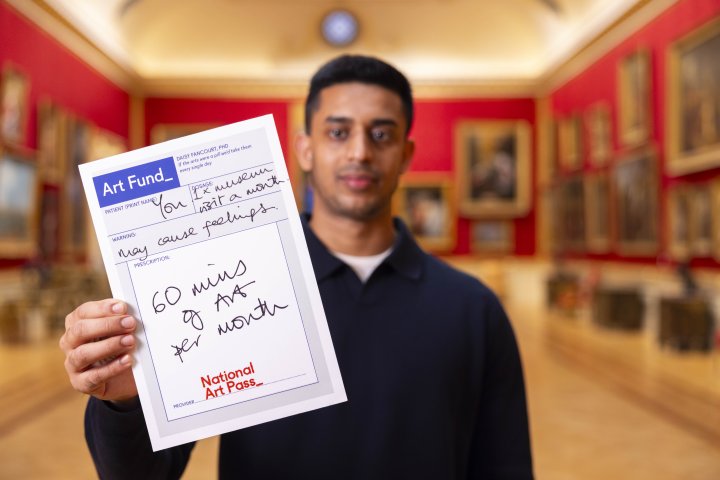
A new UK report from Art Fund and UCL scientist Daisy Fancourt proposes a Recommended Dose of Art: at least 60 minutes with art in a museum or gallery each month. Studies link regular visits to lower stress, less loneliness in older adults and less depression. Seeing real paintings in person lowered the stress hormone cortisol about 22% more than looking at copies.

In the studio

For little hands: Pick one painting at a museum, look at it for five minutes, then draw it from memory at home.

For seniors: Make a monthly museum date with a friend and sketch one artwork in pencil before you leave.

Read the full story at Art Fund artfund.org · Image: David Parry / Assignments / Press Association, via Art Fund

Plants in art

A museum asks us to really look at plants

On November 17 the University of Iowa’s Stanley Museum of Art opens Plants and Power, more than 50 artworks about plants. Its curator says people tend to overlook plants, and the show asks us to look again: a fiddle-leaf fig painted on a mailing envelope, flowers made from paper and fabric, and pictures by the 1800s botanist Anna Atkins. A biology professor helped plan it.

In the studio

For little hands: Pick one leaf, trace its veins with a crayon, then paint it the exact green you see.

For grown-ups: Paint a houseplant you own on an old envelope, letting the printed words and stamps show through.

Read the full story at Stanley Museum of Art, University of Iowa stanleymuseum.uiowa.edu · Image: Fidencio Fifield-Perez, dacament 14, 2018. Photo: Paul Salveson, Stanley Museum of Art

In the library Deciduous & Evergreen

Cave art

280 Ice Age drawings hiding on a tourist cave’s walls

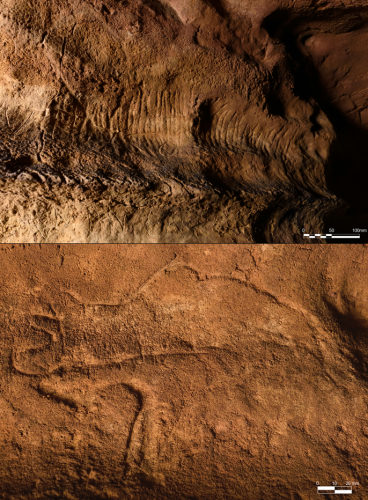
For more than sixty years, visitors walked through Cova de la Font Major, a cave in Catalonia, Spain, and some even scratched their names on its walls. Nobody noticed what was already there: 280 Ice Age engravings, including a bear drawn with its ears facing you and its mouth slightly open. Archaeologists say the drawings belong to a style all their own.

In the studio

For little hands: Press lines into foil or clay with a pencil, then shine a flashlight from the side to make them appear.

For grown-ups: Scratch a bear into black scratchboard, then compare how it looks under overhead light and under a low, sideways lamp.

Read the full story at Antiquity antiquity.ac.uk · Image: Josep Maria Vergès Bosch & Míriam Salas-Altès

In the library Dripstone Caves

Creativity research

Preschoolers aren’t more creative than adults, just bolder

Most of us assume little children are more creative than grown-ups. Researchers at the University of Graz in Austria put that to the test. Ninety-two preschoolers and 70 adults drew freely, then drew an animal that does not exist. Judges rated the adults’ work as more creative. But the children felt surer, more eager and less worried. Their real gift is confidence.

In the studio

For little hands: Draw an animal that does not exist, then give it a name and tell someone what it eats.

For grown-ups: Set a timer for eight minutes and draw an imaginary animal. No erasing and no apologizing for it.

Read the full story at PLOS One journals.plos.org · Image: Saretzki, Fratzl, Barbot and Benedek, PLOS One (CC BY 4.0)

Structural color

Colors borrowed from a pearl and a feather

A pearl shines because thin stacked layers bounce light back and forth, and a blue feather looks bright partly because dark pigment underneath soaks up stray light. Chemists at Tohoku University in Japan copied both tricks. They grew uneven mineral layers that glow like pearl, then dusted them with an iron compound that absorbs some light. Out came shimmering red, blue, purple and green powders.

In the studio

For little hands: Paint a bird on black paper with pearly watercolor and watch it shimmer as you tilt the page.

For grown-ups: Try a thin pearlescent glaze over a dark underlayer, then over white, and compare where the color glows brighter.

Read the full story at Tohoku University, Advanced Institute for Materials Research wpi-aimr.tohoku.ac.jp · Image: Shu Yin et al., Tohoku University

In the library Feathers & Scales

Art + aging

A free Saturday studio for artists over 55

In Salt Lake City, the Utah Museum of Fine Arts runs a free eight-week studio for artists 55 and up. Each Saturday, people walk through a show of art the museum collected over 25 years, then make their own: phone photos that tell a story, abstract acrylic paintings on wood, and loose, lively drawings of buildings. Every material is free.

In the studio

For little hands: Look at one painting together, then paint your own version with acrylics on a smooth scrap of wood.

For seniors: Snap three phone photos of a favorite street, then draw one building fast with loose, wobbly lines.

Read the full story at Utah Museum of Fine Arts umfa.utah.edu · Image: Utah Museum of Fine Arts

Seattle scene

The great northern forest comes to Seattle

On November 7 the Burke Museum in Seattle opens Knowing Nature, a Smithsonian traveling show about the boreal forest, the giant northern forest that circles the top of the globe. Wildlife photographs share the room with art made from the forest itself: beaded earrings of birchbark and moose hide, and snowshoes of ash wood and rawhide. Everything is labeled in English and Spanish.

In the studio

For little hands: Collect a fallen leaf, a twig and some bark, then glue them into a tiny forest collage.

For grown-ups: Paint a dark row of evergreens against a pale winter sky, adding layers from the back row forward.

Read the full story at Burke Museum burkemuseum.org · Image: Earrings by Meagon Anishinabie (Oji-Cree Treaty 5), photo by James Kegley, Burke Museum

In the library Deciduous & Evergreen

Back-pressure painting

He paints from the back of the canvas

Most painters work on the front of a canvas. Korean artist Ha Chong-Hyun, born in 1935, works from the back. He presses thick oil paint into rough burlap, like the sacks that carried rice to Korea after the war, until it squeezes through the weave to the front. More than 50 of his paintings are on view in San Francisco through January 25.

In the studio

For little hands: Smear thick paint on the back of loose-weave burlap, press with a spoon, then flip it over to see what squeezed through.

For grown-ups: Try a painting made by pressure, not brushstrokes: push paint through coarse fabric and let the weave decide the marks.

Read the full story at Asian Art Museum, San Francisco exhibitions.asianart.org · Image: Photo © An Chunho, courtesy Tina Kim Gallery

Painting with light

Forty years of photographs without a camera

Garry Fabian Miller has not used a camera in forty years. In a darkened room he shines light through colored glass, water and cut paper straight onto photographic paper, sometimes for hours, until glowing suns and moons appear. From November 26, Oxford’s Ashmolean Museum hangs his pictures beside moonlit landscapes by Samuel Palmer, an artist he first admired there in the 1970s.

In the studio

For little hands: Shine a flashlight through a glass of colored water onto white paper and trace the glowing shape you see.

For grown-ups: Paint the same view twice, once by day and once by moonlight, and notice which colors disappear first.

Read the full story at Ashmolean Museum ashmolean.org · Image: © Garry Fabian Miller, courtesy Ashmolean Museum

In the library Transmitted Light · Borrowed Light

Art meets climate science

Art students draw what climate scientists dig up

Scientists studying climate shared their research with art students at Belmont University, and each student turned one project into a picture. One slices a Maine salt marsh open like a layer cake: every band of mud holds a moment in time, from ancient clam shells to a pitchfork and a steam engine. The work is on view at UMass Amherst’s science library through November 19.

In the studio

For little hands: Layer colored sand or torn paper strips in a clear jar, then draw what might be buried in each layer.

For grown-ups: Paint a cross-section of a place you know, giving each soil layer a date and one object from that time.

Read the full story at Northeast Climate Adaptation Science Center, UMass Amherst necasc.umass.edu · Image: Julia Bass, Belmont University, via NE CASC

In the library Biogenic Sand

Feathers & art

Five hundred years of chasing a dazzling bird

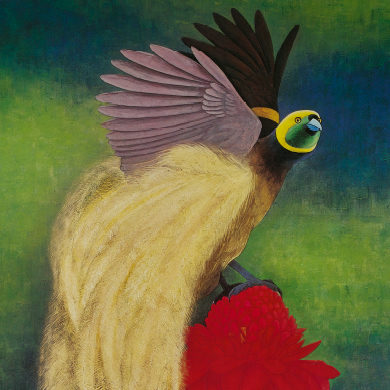
Birds of paradise live in the forests of New Guinea, and for five hundred years their feathers have traveled the world. A Paris museum has gathered nearly 190 works about them: jewelry, paintings, preserved birds, fashion and illustrated books. Scientists, scholars and artists from New Guinea helped shape the show, so the birds are seen through local eyes too. It closes November 8.

In the studio

For little hands: Paint a bright bird, then press on torn tissue-paper tail feathers in gold, red and green.

For grown-ups: Paint one real feather from life, and watch how its color shifts as you tilt it toward the light.

Read the full story at Musée du quai Branly – Jacques Chirac quaibranly.fr · Image: Musée du quai Branly – Jacques Chirac

In the library Feathers & Scales

Chinese enamel

Powdered glass, painted on and baked to a shine

A free new show at the Fitzwilliam Museum in Cambridge, England, gathers Chinese enamels made from the 1600s on: teapots, bowls, tea caddies and plates. Painted enamel is colored glass ground to powder, brushed on like paint, then fired until it melts into a hard, shiny skin. Chinese workshops used it on porcelain, glass and copper, and made pieces for buyers in Europe.

In the studio

For little hands: Paint bright flowers on a paper plate, then brush clear glue over them for a shiny, enamel-like glaze.

For grown-ups: Try an all-over pattern of flowers and leaves on a deep blue ground, outlining every leaf in fine dark ink.

Read the full story at The Fitzwilliam Museum fitzmuseum.cam.ac.uk · Image: The Fitzwilliam Museum, University of Cambridge

In the library Transmitted Light