
Borrowed Light
The idea
What this lesson is about
Learn that the Moon travels around the Earth, that its changing shape in the sky is called a phase, and that it shines by reflecting the Sun rather than making light of its own — then paint a glowing night sky in oil/chalk pastel on black paper.
The Moon looks different every night. Some nights it is a thin curve, some nights a bright circle, and some nights it seems to disappear altogether.
Here is the surprise: the Moon never actually changes shape. It is always a ball of rock, and it is always half-lit by the Sun. What changes is where the Moon is as it travels around the Earth — and therefore how much of that lit half we can see from down here.
The other surprise is that the Moon makes no light of its own at all. Every bit of moonlight you have ever seen is sunlight, bounced.
The science
Why it actually happens
How deep do you want to go?
The lesson. Everything you need to make the art and know why it works.
Stand somewhere and look up
Choose where you are standing, then slide the day and the time. The Sun and the Moon are drawn where they really are, and the dotted line is the whole path each one takes that day. Try the North Pole in June.
🕗Date and time: Sep 21 2026, 8:30 PM 🌔Phase: Waxing Gibbous ☀️The Sun: 1:53 PM – 2:09 AM 🌙The Moon: already up – 7:54 AM
The Moon is always half lit, and its bright side always faces the Sun — even after the Sun has gone down. That is why the horns of a crescent point the way they do.
Tonight's Moon, where you are
This is the real Moon for tonight — the phase you will actually see, and the times it comes up and goes down where you live. Come back tomorrow and every number will have moved.
- 🌙 Moonrise
- —
- 🌘 Moonset
- —
- 🌇 Sunset
- —
- 🌅 Sunrise
- —
The next few nights — watch moonrise drift later:
Moonrise slides about fifty minutes later each night. That drift is why the Moon is high after dinner one week and nowhere to be seen the next.
The Moon comes up and goes down
The Sun comes up in the morning. It goes down at night. You already knew that!
The Moon does the same thing. It comes up. It goes down. We call those moonrise and moonset.
Here is the funny part. The Moon does not wait for night. Sometimes it comes up in the middle of the day. Look up on the way home from school — a pale Moon is often right there in the blue sky.
Every night the Moon comes up a little bit later. That is why it is high over your house one week, and gone to bed early the next.
Why the Moon is late every night
Moonrise and moonset are just like sunrise and sunset — the Moon climbs up one side of the sky and sets on the other. The difference is that the Moon keeps changing its schedule.
Each night the Moon rises about fifty minutes later than the night before. A week of that adds up to hours. So the Moon owns the evening for a while. Then it seems to disappear. Then it turns up in the morning sky instead.
The reason is that the Moon is moving. While Earth spins once, the Moon slides a little further along its orbit. Earth has to spin an extra fifty minutes to catch up with it.
And the phase tells you the schedule. A full moon rises just as the Sun sets, and stays up all night. A new moon travels with the Sun through the daytime. That is exactly why you cannot see it.
A calendar made of moons
Long before printed calendars, people kept time by the Moon. It is the obvious clock: a shape anyone can check from a doorway, repeating on a schedule you can count.
One full cycle — new moon back to new moon — takes 29.5 days. That is a lunar month, and it is where our word "month" comes from. Twelve of them make 354 days, about eleven short of a solar year, which is the problem every lunar calendar has to solve. The Islamic calendar lets its months drift through the seasons. The Hebrew and Chinese calendars add a whole leap month every few years to stay in step. The Gregorian calendar most of the world uses gave up on the Moon entirely and stretched the months to fit the Sun.
Moonrise follows the same cycle. Each night the Moon rises roughly 50 minutes later, because in the time Earth takes to spin once the Moon has moved about 13° further around its orbit — and Earth has to keep turning to catch up.
That is also why a moon can be up in broad daylight. "Night-time" is not a property of the Moon; it is where you are standing. Half the time, the Moon is above your horizon while the Sun is too.
The arithmetic of the month
The Moon completes one orbit relative to the fixed stars in 27.32 days — the sidereal month. But the phase cycle you can see takes 29.53 days — the synodic month. The gap is not an error; it is the Earth moving.
While the Moon goes around us, we go around the Sun. By the time the Moon has returned to the same place against the stars, the Sun–Earth–Moon geometry has shifted, and the Moon needs about 2.2 more days to catch back up to the same phase. In rates: the Moon moves 360°/27.32 d ≈ 13.18° per day, Earth–Sun geometry drifts 360°/365.25 d ≈ 0.99° per day, and the phase cycle runs at the difference — 360 / (13.18 − 0.99) ≈ 29.5 days.
The same difference sets moonrise. Earth rotates 360° in 23.93 h, so catching up 13.18° of lunar motion takes an extra 13.18 / 15.04 ≈ 0.88 h — the familiar ~50 minutes later each night.
That delay is an average, not a constant. What you actually experience depends on the angle the ecliptic makes with your horizon, which changes with season and latitude. Near the September equinox in the northern hemisphere that angle is shallow, and the delay drops to as little as 25 minutes for several nights running. The harvest moon rises in near-twilight evening after evening, which is the reason it has a name.
Go further
Look it up tonight
Two places worth a visit before you go outside with your paper.
A friend says they saw a full moon high overhead at noon. What do you tell them?
The Moon looks like a bright circle tonight. Why?
What you need
Gather these before you start
Black paper is doing real work here: on white paper a moon has to be outlined, but on black it can simply be light.
Make it
Gather your things, then paint
Paint your moonrise
Work from dark to light. On black paper the pastel is the glow, so every mark you make is adding light to the picture. Almost none of this is drawing: you cut two shapes out of white paper, rub color off their edges, and the paper does the rest.
-
Draw a Moon and a mountain range
Take your sheet of white paper. Up in one corner draw a circle for the Moon — trace around a roll of tape or the bottom of a cup if that is easier. Then draw a jagged line of mountains all the way across the bottom. Press lightly. Neither of these is your picture. They are the two stencils that are going to make it.
about 5 minutes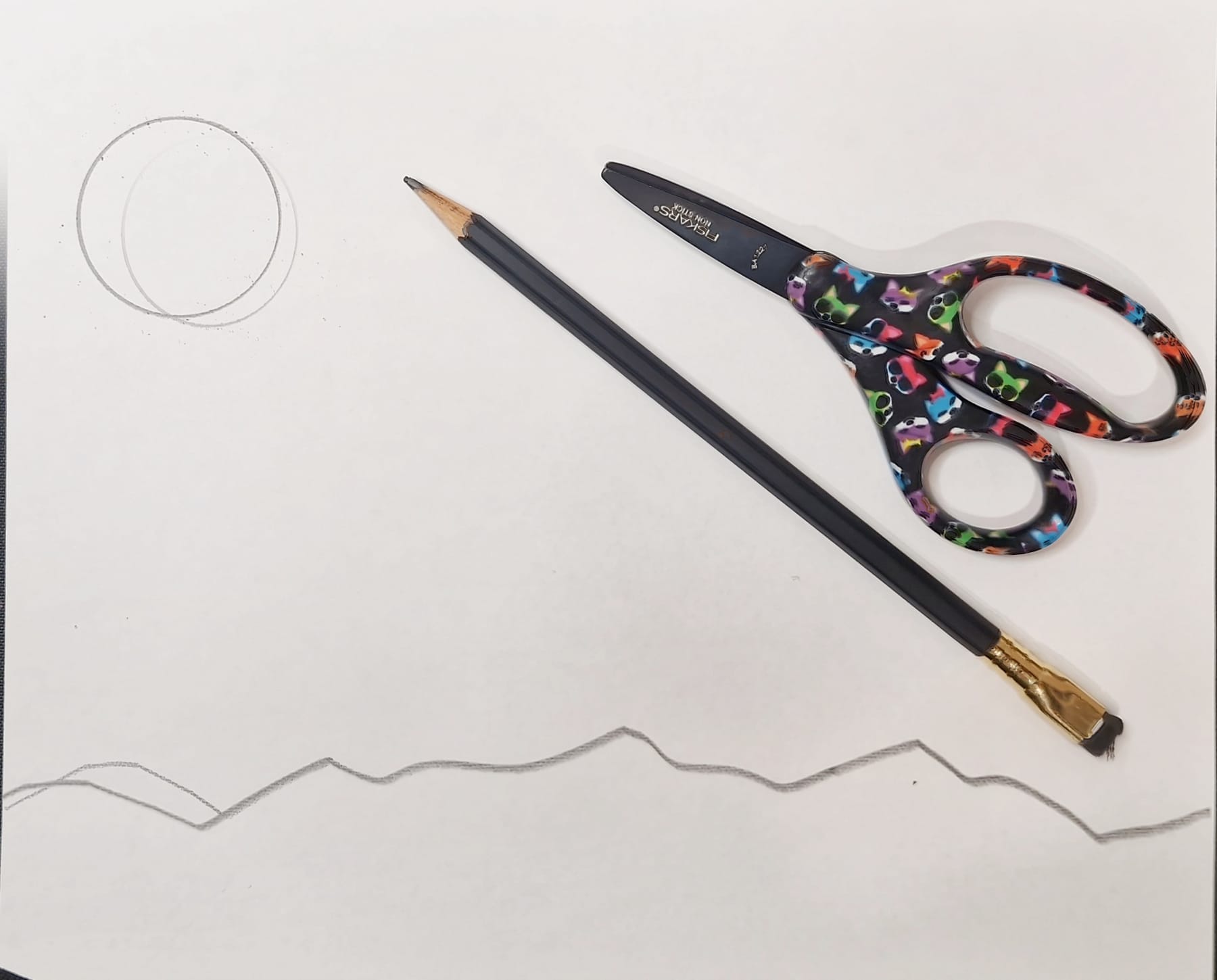
Put the circle near a corner. A Moon in the middle of the sky has nowhere to have risen from.
-
Cut them out and lay them where they go
Cut out the circle. Then cut along the mountain line, so the bottom of the sheet comes away as one long ridge. Lay them both on your black paper — the circle up in its corner, the mountains along the bottom. Stand back and look. That is your whole picture, in white, before a single color has gone down.
about 8 minutes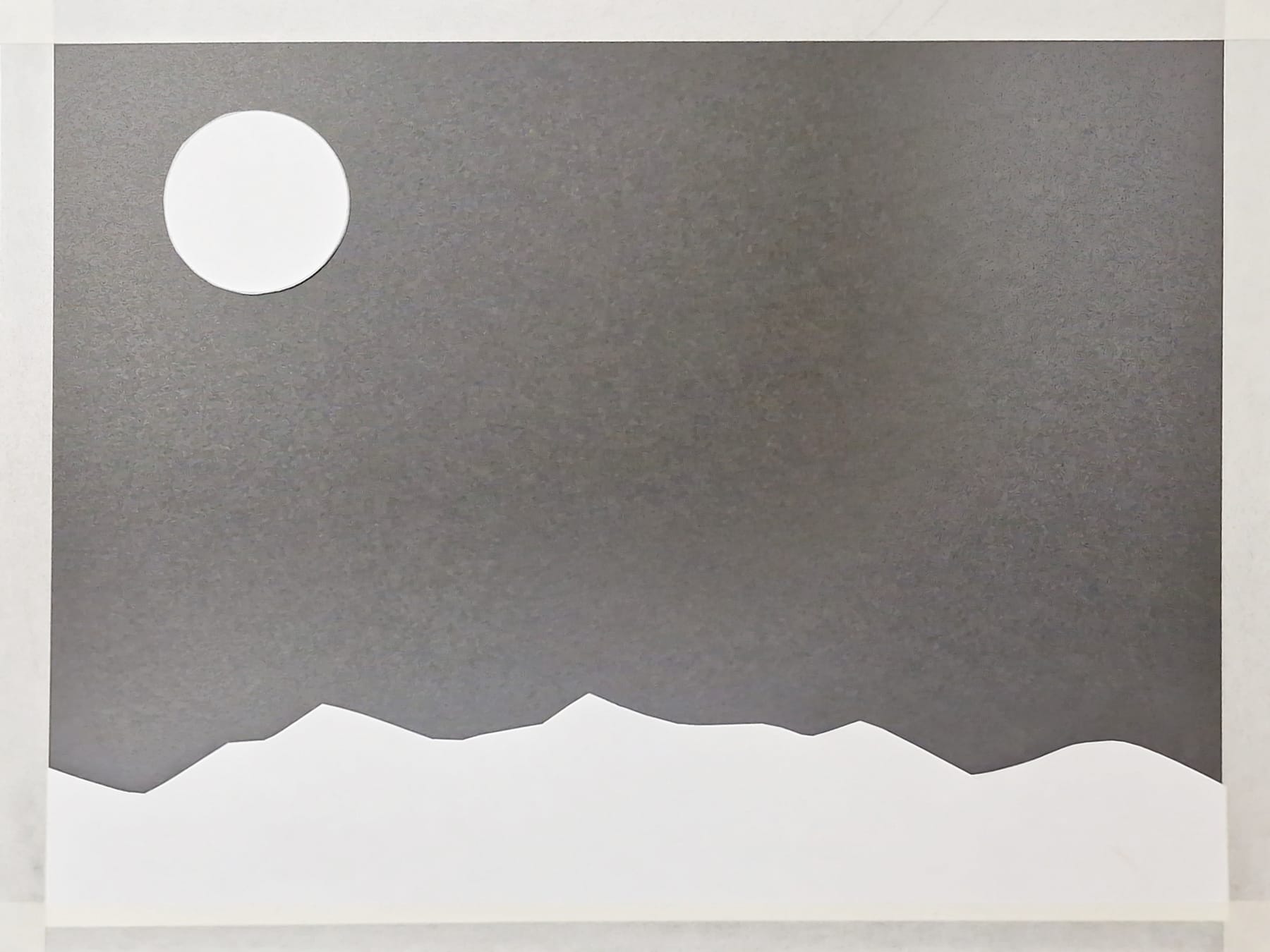
Cut slowly. Every edge you cut here is an edge the light is going to print against.
-
Print the Moon's glow
Pick the circle back up and color a thick band of blue right around its rim. Lay it back in its corner, blue side down, and hold it still with one finger. Now rub outward from the edge — away from the circle, all the way around, like rays going out. Lift it straight up. There is a ring of blue light with a clean dark circle in the middle of it, and that circle is where your Moon is going to sit.
about 10 minutes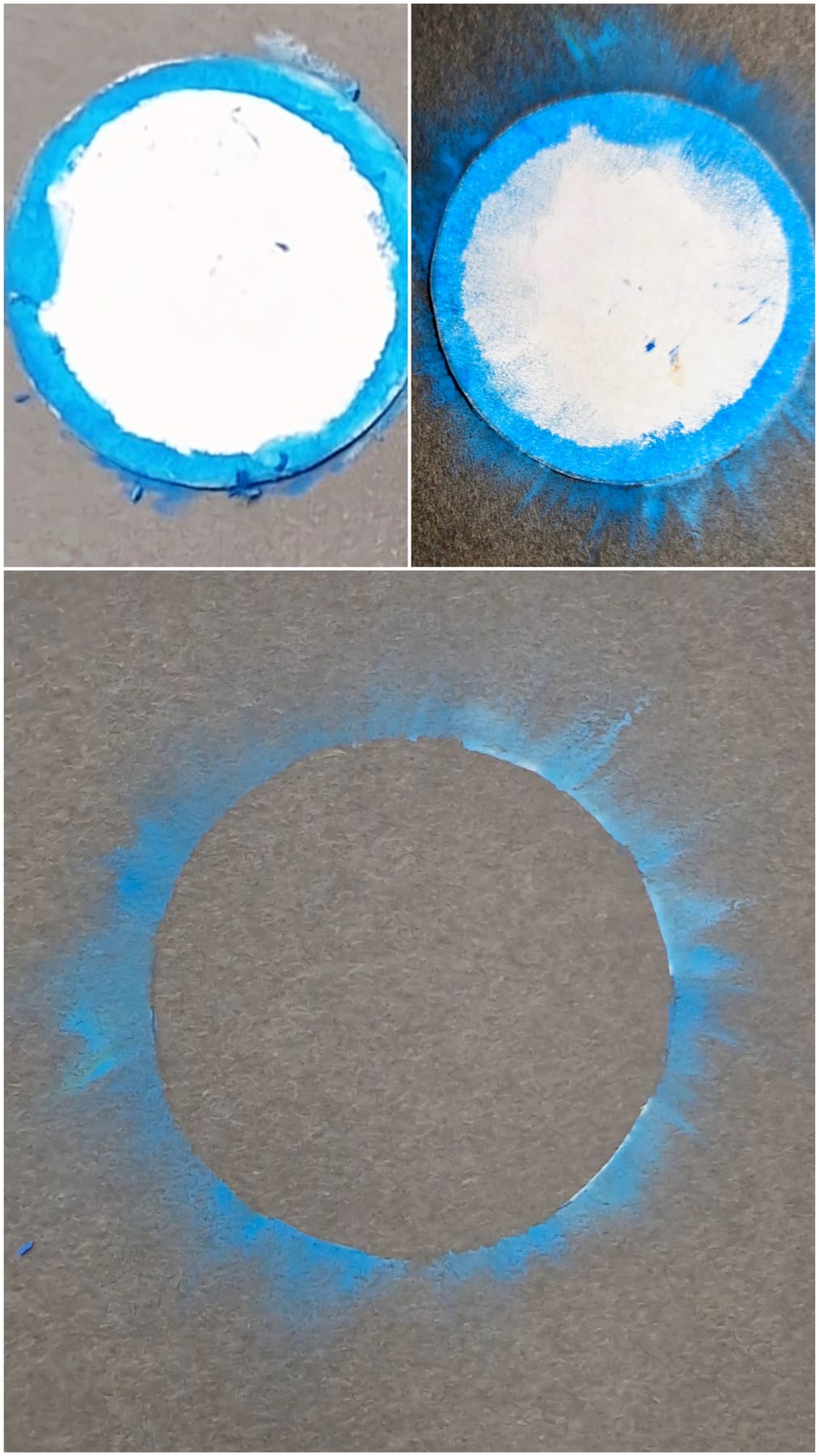
Rub outward, never round and round. Round and round makes a smudge. Outward makes light.
-
Rub the sunset up off the ridge
Hold the mountain ridge down along the bottom. Draw a line of yellow right along its jagged top edge, then orange just above the yellow, then blue above that. Now rub each one upward, away from the ridge, until they melt into one another. Brightest down at the mountains and darkest high up — because down there is where the Sun has only just gone.
about 10 minutes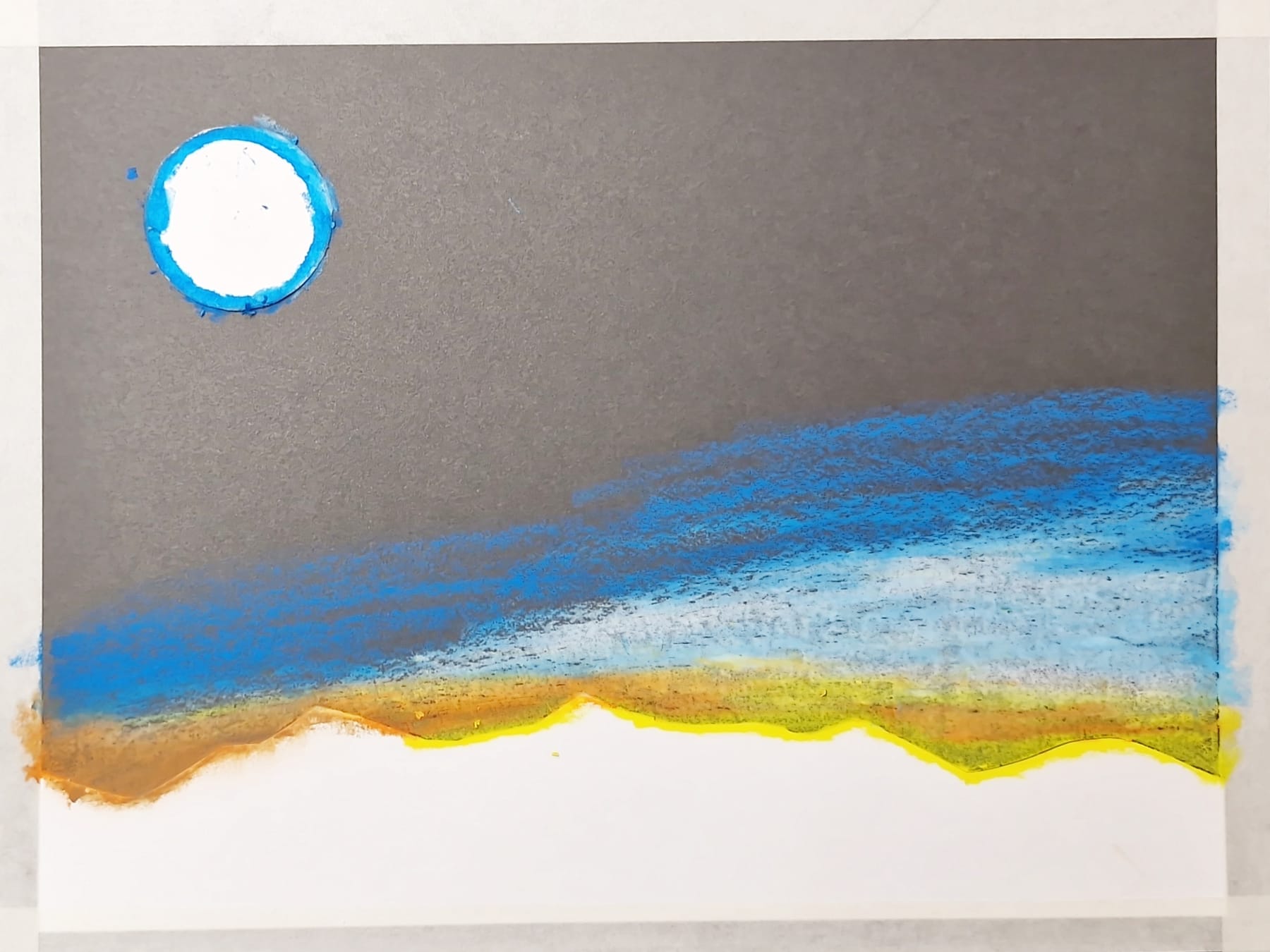
Yellow closest to the mountains, blue highest up. Get that order right and the sky looks like evening all on its own.
-
Lift the ridge and set your Moon in place
Lift the mountain range straight up. Underneath is black paper the color never reached — solid dark mountains against a glowing sky, and you never drew them at all. Now cut out your printed Moon and glue it into the clean circle inside the blue ring.
about 8 minutesSpread your glue in the middle of the Moon, not around its edge. Glue on an edge squishes out and shines when it dries.
-
Fill the sky with stars
Press small white dots into the dark part of the sky — press once and lift. Let them gather in some places and thin out in others. Keep them well away from the glow around the Moon and from the bright band over the mountains. Stars only show where the sky is properly dark, and that is exactly why yours will look real.
about 6 minutes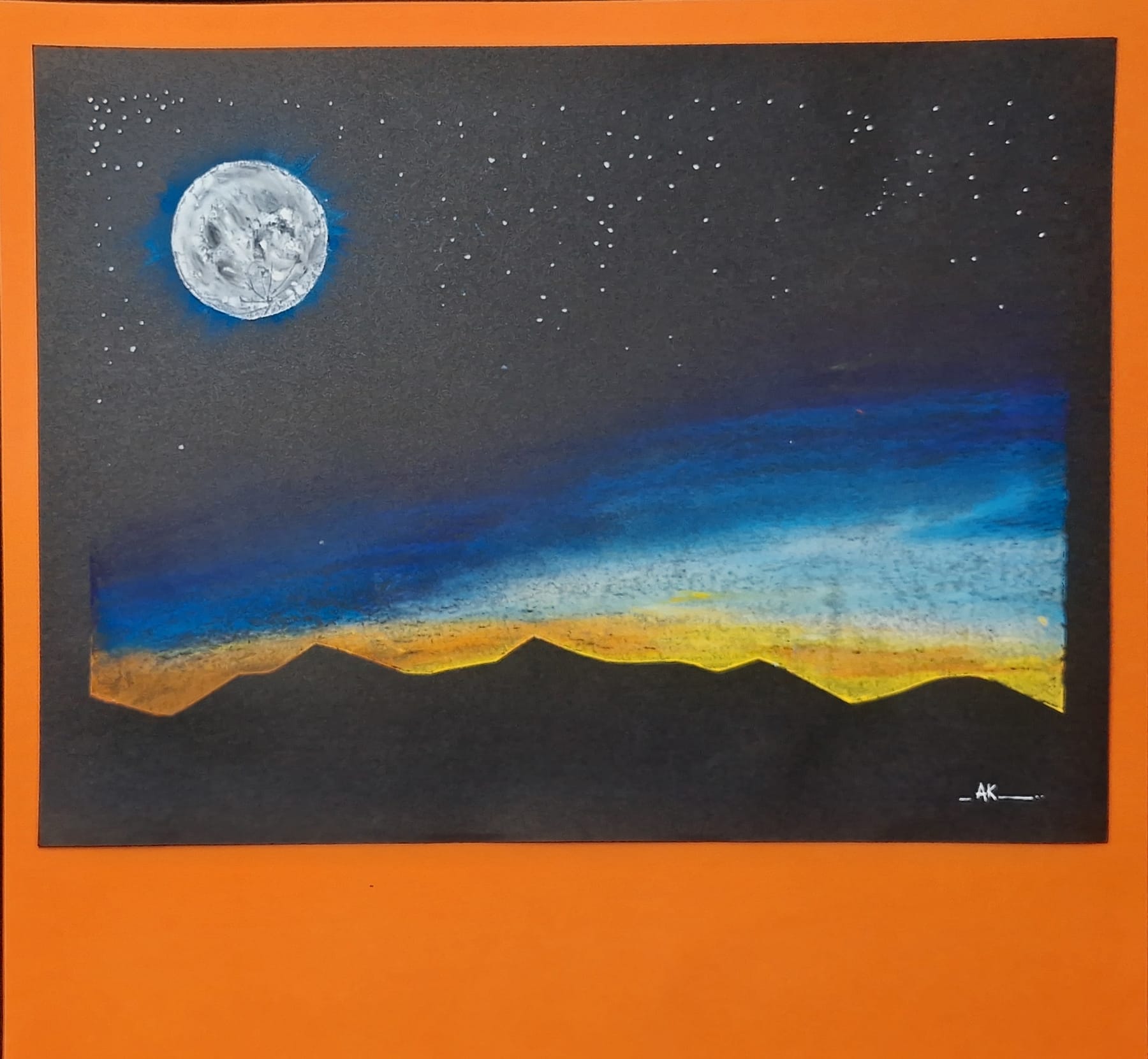
Stand it up and look from across the room. If the Moon is still the brightest thing on the paper, you are finished.
-
Now make it show every phase
Cut one more circle out of gray paper, exactly the size of your Moon. Slide it across. Cover nearly all of the Moon and you have a thin crescent; cover half and you have a half Moon; take it away altogether and the Moon is full. Nothing about your Moon changed. All that moved was the shadow — and that is the whole of what a phase is.
about 5 minutesThis is the part worth showing somebody. Hand them the gray circle and let them make the phases themselves.


There’s a whole library where this came from
This lesson is open to everyone. The rest open when you enroll — every stop of every lesson in your term, online, for as long as the term runs.