Fresh Paint

September 2026

← The latest briefs

Pigment detectives

A laser reads the paint on a possible da Vinci

A portrait of the Roman emperor Domitian carries a signature, "L daVinci," that shows only when light hits it right. Uppsala University scientists shone a laser on specks of its paint and named 13 pigments. Twelve existed in Leonardo's day. Prussian blue, first made in the early 1700s, turned up in two spots, including the laurel wreath: a later touch-up, not proof of a fake.

In the studio

For little hands: Paint a picture with three colors, then add a fourth later. Can a friend spot which color came last?

For grown-ups: Look up when your favorite paint colors were invented, then try a small still life using only colors from 1500.

Read the full story at Uppsala University uu.se · Image: Uppsala University
Luminous pigments

Why glow-in-the-dark art slowly loses its shine

Most paint is seen because it bounces light back. Fluorescent and glow-in-the-dark pigments do something stranger: they soak up light and give it back as a glow. Chemist Sarah Schmidtke Sobeck and museum scientist Gregory Smith study why those colors fade in art, like Stephen Sprouse's DayGlo fashion. A surprise: damp air can dull a glow as much as light does.

In the studio

For little hands: Paint a night sky with glow-in-the-dark paint, charge it under a lamp, then switch off the lights and watch it shine.

For grown-ups: Try one highlighter-pink stroke beside ordinary pink paint, and compare them under sunlight and a blacklight.

Read the full story at American Chemical Society acs.org · Image: Indianapolis Museum of Art at Newfields, Gift of Joanne Sprouse, in memory of her son Stephen Sprouse

In the library Emission Lines

Stories in pictures

A whole museum for stories told in pictures

A new museum in Los Angeles is built around one idea: people have always told stories with pictures. The Lucas Museum of Narrative Art opened September 22 with more than 30 galleries, from prehistoric cave paintings to comics, manga, murals and film. Frida Kahlo hangs near Norman Rockwell, and a free research library holds a deep collection on children's book illustration.

In the studio

For little hands: Fold paper into four boxes and draw a story in them: a beginning, a problem, a surprise, an ending.

For grown-ups: Paint one picture that tells a whole story, then ask a friend to guess what happened just before it.

Read the full story at Lucas Museum of Narrative Art lucasmuseum.org · Image: Courtesy Lucas Museum of Narrative Art. Photo by Hufton+Crow.

Marsh printmaking

A printmaker and a soil scientist map the marsh

More than a century ago, crews cut straight ditches across Atlantic salt marshes to drain mosquito pools. The grid never left. Printmaker Heather McMordie and soil scientist Edward Landa turned that history into art: cyanotypes, drawings, and etchings allowed to corrode naturally, so chemistry finishes what the artist starts. It is on view in Washington, DC through December.

In the studio

For little hands: Lay leaves and string on sun-print paper outside, then rinse, and watch sunlight and water turn everything blue.

For grown-ups: Try a cyanotype at home, or press rusty washers onto damp paper and let iron stain its own quiet map.

Read the full story at Heather McMordie heathermcmordie.com · Image: Heather McMordie

In the library Natural Geometry

Northwest glass

Tacoma builds a room for Lino's glass

Lino Tagliapietra started blowing glass on Murano at eleven and was called maestro by his twenties. He moved to Washington in 1979 and has now given Tacoma's Museum of Glass 175 of his works. A new 4,000-square-foot gallery opens this December to hold them, proof that the Northwest became a world capital of hot glass.

In the studio

For little hands: Color on clear plastic lids with markers, hold them up to a window, and watch color turn into light.

For grown-ups: Set a glass bottle on white paper in sunlight and draw the bright curved lines of light it casts.

Read the full story at Museum of Glass museumofglass.org · Image: Museum of Glass

Also worth a glance The Hot Shop stays open through the renovation, with live glassblowing and free admission on third Thursday evenings. Take a look →

In the library Transmitted Light

Light & optics

A show where light is the material

This Thursday the Boulder Museum of Contemporary Art opens The Gravity of Light, where seven artists treat light itself as a material. Expect photographs, video, drawings and installations built from color, shadow and contrast. One drawing is nothing but fine colored lines, laid side by side until the paper seems to glow from the inside. Light you can almost feel.

In the studio

For little hands: Tape colored cellophane over a window, then chase the colored patches of light that land on the floor.

For grown-ups: Draw one square filled with close parallel pencil lines, varying pressure only; watch flat graphite turn into glowing light.

Read the full story at Boulder Museum of Contemporary Art bmoca.org · Image: Anne Lindberg, courtesy Boulder Museum of Contemporary Art

In the library Transmitted Light

Science illustration

Thousands of tiny dots win a world illustration prize

Jessica Eggers is a fisheries biologist who draws. For Gonzo Ichthyology, she teamed up with veteran fish scientist Milton Love and inked 288 pages entirely by hand, building every shadow out of thousands of black pen dots. It is the old stippling method of early naturalists, run gloriously wild. This month it won the World Illustration Awards top New Talent prize.

In the studio

For little hands: Draw a fish with a marker, then fill its darkest parts with dots, packing them closest where the shadow is deepest.

For grown-ups: Try stippling a leaf in ink, letting dot spacing alone build light and shade, with no lines and no shading strokes.

Read the full story at World Illustration Awards, Association of Illustrators worldillustrationawards.com · Image: Jessica Eggers / World Illustration Awards

In the library Feathers & Scales

Natural pigments

Alaska's landscape is becoming a library of color

In Juneau, artist Christine Carpenter forages leaves, berries and earth, then grinds them into paint. A new grant from the Juneau Community Foundation will turn that practice into an online pigment library, showing Alaskans which local plants and materials give which colors. Gathered in the field, extracted in the studio, then mapped for anyone to look up. A whole landscape, sorted by hue.

In the studio

For little hands: Crush a few blackberries and some turmeric with a spoon, paint with the juice, and watch which color fades first.

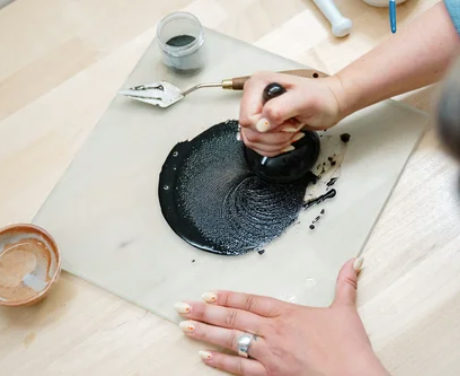
For grown-ups: Grind a pinch of sidewalk dirt or brick dust with water and gum arabic to make your own earth watercolor.

Read the full story at Juneau Community Foundation juneaucf.org · Image: Juneau Community Foundation

Conservation science

Scans catch Reynolds changing his mind on a famous portrait

This week the Getty Center in Los Angeles hung Joshua Reynolds's nearly eight-foot Portrait of Mai, the first Polynesian visitor to Britain, painted around 1776. Before the unveiling, conservators scanned the canvas with X-rays and special cameras and discovered Reynolds changed his mind mid-painting, moving Mai's hand and reworking his head. The scans even named his pigments: vermilion, carbon black, and earthy iron reds.

In the studio

For little hands: Draw a face in white crayon, brush watercolor over it, and watch your hidden drawing appear like a museum scan.

For grown-ups: Mix a skin tone from red, yellow ochre, and a speck of black, the same earthy palette Reynolds reached for.

Read the full story at Getty Museum getty.edu · Image: National Portrait Gallery, London / Getty

Also worth a glance Watch tapa bark cloth being made by hand at the Getty Center, September 18 to 20, free with a reservation. Take a look →

Fungi & art

A new book gathers 200 artworks all about mushrooms

Phaidon has already made big picture books about butterflies, birds, oceans, and trees. Next up, this October: fungi. Colossal previews the book, which pairs more than 200 images across thousands of years, from an ancient carved mushroom stone to Hilma af Klint's 1893 watercolor of a cultivated mushroom and Carsten Höller's gallery of giant red toadstools hanging upside down from the ceiling.

In the studio

For little hands: Lay a store-bought mushroom cap gills-down on paper overnight, then lift it to find a spore print to trace and color.

For grown-ups: Paint a mushroom in watercolor the way af Klint did, building the cap's shadow in three thin layers, drying between.

Read the full story at Colossal thisiscolossal.com · Image: Attilio Maranzano, courtesy Carsten Höller, Fondazione Prada and Phaidon, via Colossal

Also worth a glance Also on Colossal: Inploration, a new book where nearly 100 artists look to space to understand Earth. Take a look →

Fiber art

Loom bands become brushstrokes in Hannah Buechler's wool paintings

Remember loom bands, the tiny rubber loops that turned up in couch cushions a decade ago? Artist Hannah Buechler loops thousands of them onto tufts of colorful wool, building wall pieces that look like bold, brushy paintings until you step close. Each wool tuft is a brushstroke, soft natural fiber held tight by stretchy synthetic rubber.

In the studio

For little hands: Wrap loom bands around cotton balls or wool tufts, then arrange the fuzzy bundles on felt into a rainbow hill.

For grown-ups: Try painting a landscape with wool roving instead of paint, letting each tuft stand in for one Impressionist brushstroke.

Read the full story at Colossal thisiscolossal.com · Image: Hannah Buechler, via Colossal

Also worth a glance Phaidon's new book Fungi: The World of Mushrooms gathers more than 200 artworks, photos and objects about mushrooms, out October 15. Take a look →

Art + aging

Delaware doubles down on free art classes for seniors

A national grant just expanded Delaware's Access Creative Aging program, which sends trained teaching artists into public libraries and senior centers to teach pottery, painting, poetry, dance, and jewelry design. More than 400 adults over 55 already take part, and nearly all report feeling more confident and accomplished. The goal: 480 participants across 32 sites by 2028.

In the studio

For grown-ups: Give yourself four weeks of watercolor color-mixing with friends, and end with a small show; sharing work builds confidence.

For little hands: Shape one lump of clay into pinch pots beside a grandparent, and compare how hands of every age work the same clay.

Read the full story at Delaware Division of the Arts news.delaware.gov · Image: Delaware Division of the Arts, via news.delaware.gov

Also worth a glance A new global history of printmaking argues that prints were the first art made for everyone. Take a look →

Ocean ecology

Tiny seahorses win Ocean Photographer of the Year

A quiet black-and-white photo of an adult seahorse with two tiny babies, tucked in seaweed near Moorea, French Polynesia, just won Julien Anton the 2026 Ocean Photographer of the Year. Colossal shared the winners this week, and the whole set is a reminder that the smallest sea creatures can steal the show.

In the studio

For little hands: Paint a seaweed forest with watercolor, then hide a curly-tailed seahorse in it, matching its colors so it disappears.

For grown-ups: Try a black-and-white ink wash study of one photo to explore value, contrast, and negative space without color.

Read the full story at Colossal thisiscolossal.com · Image: Julien Anton, Ocean Photographer of the Year 2026, via Colossal

Also worth a glance A new book, Inploration, gathers nearly 100 artists who look to space to understand Earth. Take a look →

In the library Foundation Species